Reimagining DMO Digital Strategy and the Visitor’s Journey, with Kelly Blazosky
Episode 502

In this episode of Destination on the Left, I talk with Kelly, a long-time tourism industry leader who has spent over 26 years working across both destination marketing organizations and the technology side of the visitor economy. Now serving in the vendor space with Tourism Exchange USA, Kelly brings a unique dual perspective on how destinations can evolve their digital strategy in an AI-driven world. We explore how DMOs can move beyond inspiration and into full-funnel booking capability, the role of live inventory in simplifying distribution, and why education and collaboration are essential as tourism continues to shift toward a more connected, data-informed ecosystem.

What You Will Learn in This Episode:
- How AI is changing the way travelers search, plan, and book trips—and what that means for destination marketing organizations
- Why DMOs need to think beyond inspiration and clicks to create a full “continuous journey” that includes booking capability
- How live inventory technology is transforming distribution by connecting suppliers, DMOs, and consumers in real time
- What it means for DMOs to act as a distribution channel for local businesses and how that shifts stakeholder relationships
- How Tourism Exchange USA helps destinations support both digitally connected and offline tourism businesses
- Why attribution and real booking data are becoming essential tools for demonstrating tourism impact and campaign success
- How travel trade connectivity expands destination reach through curated, bookable itineraries and discovery tools
AI, Digital Strategy, and the Evolution of the Visitor Journey
A major theme in the conversation is how quickly AI is reshaping traveler behavior. Kelly shares how people are already using tools like ChatGPT to plan complex trips end-to-end, signaling a shift in how destinations must think about visibility and relevance. In this environment, DMOs are no longer just storytellers or inspiration hubs—they need to ensure they are structured to be found, interpreted, and prioritized by AI-driven systems.
This requires a shift in digital strategy from isolated campaigns and content to an integrated ecosystem where inspiration, information, and booking are connected. Kelly emphasizes that DMOs who can provide a seamless path from discovery to booking are better positioned to remain relevant as AI increasingly mediates how travelers make decisions.
Live Inventory and the DMO as a Distribution Channel
At the core of Tourism Exchange USA’s approach is live inventory integration, which allows suppliers to connect their booking systems so availability and pricing are always up to date. This removes the need for allocation models or manual coordination and ensures that what a traveler sees is what is actually available in real time.
Kelly explains how this fundamentally changes the role of the DMO, turning it into a true distribution channel for local businesses. Rather than simply driving traffic to external booking sites, DMOs can now facilitate transactions directly through curated destination pages, helping keep users within a controlled environment that reduces friction and improves conversion.
She also highlights the “matchmaker” role DMOs can play—connecting consumers with local businesses while enabling direct booking relationships that benefit both parties and keep more revenue local. This shift not only improves the visitor experience but also strengthens the economic impact within the destination.
Travel Trade, Education, and the Power of Attribution
Beyond consumer-facing strategy, Kelly discusses the importance of supporting the travel trade through a dedicated B2B marketplace that helps operators discover and book destination product. Through destination discovery pages and curated itineraries, tour operators can better understand what a region offers and confidently build it into client programs.
A key benefit of this system is improved clarity around geography, itinerary planning, and bookable experiences, which helps reduce friction in the sales process. Kelly also notes that these tools allow destinations to provide structured, evergreen itineraries that can be easily accessed, updated, and shared with trade partners over time.
Education emerges as a critical theme throughout the conversation. Kelly emphasizes that both stakeholders and new tourism businesses require ongoing onboarding and support to fully engage with digital distribution systems. Ultimately, the combination of education, live inventory, and attribution tools gives DMOs a clearer picture of campaign performance and strengthens their ability to demonstrate real economic impact to stakeholders.
Resources:
- Website: https://tourismexchangeusa.com
- LinkedIn: https://www.linkedin.com/company/tourism-exchange-usa
We value your thoughts and feedback and would love to hear from you. Leave us a review on your favorite streaming platform to let us know what you want to hear more of. Here is a quick tutorial on how to leave us a rating and review on iTunes!
Related Podcasts




Collaboration Toolkit
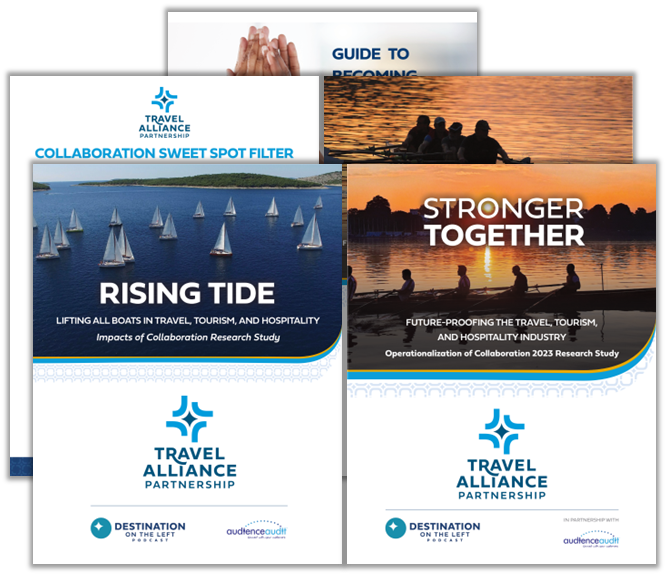
Our first research study confirmed that collaboration is a constant in the travel, tourism and hospitality industry. It is not a matter of if, but when and how, organizations will collaborate together. Our latest study reveals how organizations are putting collaboration into operation and how they are setting up systems and processes so that collaboration becomes a strategic part of the organization.
"*" indicates required fields