500 Episodes, 10 Years, and the Growing Value of Original Content in the Age of AI
When I launched my podcast, Destination on the Left, ten years ago, the acronyms LLM, GPT, AI, and AGI had not entered the marketing conversation. If I had heard of them at all, they were concepts I could not have imagined would change our world so quickly.
After attending MAICON (Marketing AI Conference) 2026 last week, I have a new appreciation for how podcasts and other forms of original content can help brands stand out.
Today, October 21, 2026, marks the 500th episode of Destination on the Left and our tenth anniversary. It’s a milestone that has me reflecting on the hundreds of conversations we’ve had with tourism professionals, the relationships we’ve developed, and the knowledge we’ve collected along the way.
When I started the podcast, my goal was to create a platform where tourism professionals could share ideas, learn from one another, and explore the power of collaboration. I knew there was value in bringing these voices together, but I didn’t fully appreciate the long-term asset we were creating.
Ten years later, I’m beginning to see that investment in a whole new light. As artificial intelligence changes how content is created, discovered, and consumed, I’m convinced that original content and the consistency required to produce it are becoming some of the most important investments a brand can make.
When Everyone Can Create Content, Originality Becomes More Valuable
One of the sessions that resonated most with me at MAICON was presented by Mike Kaput, Chief Content Officer at SmarterX and the Marketing AI Institute.
In his session, The AI-Native Content Team: How Any Team Can Outproduce (and Out-Innovate) the Competition, Mike challenged marketers to rethink what they are creating.
His advice was straightforward:
“If AI can create it out of the gate without much input from you, stop creating it. Go find the stuff AI does not know.”
We now have tools that can generate blog posts, social media content, articles, and marketing copy in seconds. What once required hours of research and writing can be accomplished in a fraction of the time.
That efficiency also means the volume of content being produced is exploding.
If everyone has access to the same tools, drawing from much of the same publicly available information, how do we differentiate ourselves?
Original Inputs Create Real Differentiation
Mike’s answer begins with what he calls original inputs: proprietary research, expert interviews, firsthand experiences, unique perspectives, and conversations that provide knowledge AI doesn’t already have.
This is where I see an enormous opportunity for the tourism industry. Every destination has people with interesting stories, experiences, and specialized knowledge. Every tourism organization has relationships with businesses, attractions, community leaders, and industry partners whose perspectives can contribute to a deeper understanding of a place.
Those conversations represent original information that cannot be created simply by asking an AI tool to write about a destination. Our opportunity is to capture that knowledge and make it accessible to the audiences we want to reach.
AI can help us organize, analyze, repurpose, and distribute that content. But we still need people to create the original ideas and experiences that make it valuable.
Consistency Builds an Asset That Compounds Over Time
There is another important part of this story that doesn’t always get enough attention: consistency.
A 2026 analysis of the Podcast Index by Slice found that only 9.4% of approximately 4.4 million podcasts had published an episode in the previous 90 days. And just 1% had reached 500 episodes.
The PodMatch industry report, which focuses on independent, interview-based podcasts, also emphasizes the importance of consistent publishing. The research identified established podcasts as those with at least 100 episodes and a regular publishing cadence. These podcasts accounted for approximately 95% of the listening activity in the analyzed sample.
These statistics reinforce something I’ve experienced firsthand: showing up consistently matters. It takes commitment to produce a podcast week after week, year after year. It requires planning, production, promotion, and a willingness to keep investing when the results are not immediately apparent.
The same is true for any sustained content initiative.
How Consistency Compounds Value
One interview might introduce an interesting perspective. Ten interviews might begin to reveal common themes. One hundred interviews can provide a deeper understanding of an industry. And over time, those conversations create a body of knowledge that becomes increasingly valuable.
Consistency also builds familiarity and trust. When audiences know they can count on you to provide thoughtful, relevant information, they have a reason to keep coming back.
For organizations willing to make that long-term commitment, I believe there’s a significant opportunity to differentiate themselves.
Building Authority in the Age of AI Search
The value of original content extends beyond the relationship with an existing audience. It also has important implications for how brands are discovered.
At MAICON, Nicole Franco, Head of Digital PR and AI Innovation at Fractl, presented a session on strengthening brand authority in search. She explored the role of expert commentary, AI prompts, and media partnerships. One of her central points was that AI search visibility is increasingly influenced by how consistently a brand and its subject matter experts appear across credible sources.
Nicole referenced research showing that branded web mentions have a strong relationship with visibility in Google’s AI Overviews. She also discussed the importance of original research, expert commentary, and coverage in publications that AI platforms frequently cite. This shifts how we think about content marketing and public relations. Alongside keywords and website traffic, we need to consider whether our organizations are recognized as credible sources on the subjects and experiences we know best.
Travel PR Shapes AI Discovery
Two articles in the July/August 2026 Travel PR issue of O’Dwyer’s reinforced this point specifically for the tourism industry.
In AI is Changing How Consumers Discover and Plan Travel, Candice Eley discussed how AI-powered search is changing the way travelers research destinations. Rather than searching through pages of results, travelers are increasingly asking detailed questions and receiving synthesized recommendations.
She emphasized the importance of authoritative coverage, consistent messaging, and specific content that addresses travelers’ questions and interests.
Lauren Mackiel made a related argument in Travel PR Has a New Destination: The Answer Box. She emphasized the importance of placing destination stories and expertise in the sources that influence AI-generated answers.
Both articles highlight the evolving relationship between earned media, original content, brand credibility, and discovery.
Our audiences may increasingly discover destinations, experiences, and businesses through AI-generated recommendations. We need to understand what information is available about our organizations, who is providing that information, and whether our expertise is represented.
Of course, creating original content doesn’t guarantee placement in an AI-generated answer. But publishing useful, credible information, making it accessible, and earning recognition from other trusted sources can strengthen the foundation for discovery in both traditional and AI-powered search.
Turning Original Content Into a Living Knowledge Base
Perhaps my biggest takeaway from MAICON was the opportunity to do more with the content we’ve already created. Mike Kaput described a content strategy that begins with original inputs and develops them into larger assets, multiple content formats, and what he calls living knowledge.
For ten years, we’ve been collecting insights from tourism professionals representing destinations, attractions, tour operators, industry associations, and businesses across the tourism ecosystem. We’ve explored collaboration, leadership, marketing, workforce development, emerging trends, destination stewardship, and countless other topics. Each conversation has been valuable on its own. But collectively, those conversations represent a significant knowledge base.
From an Archive to Living Knowledge
What happens when we look across all 500 episodes? How many recurring themes, connections, and insights might surface from conversations that took place years apart?
What new perspectives might emerge when we combine those interviews with our original research on collaboration and the industry knowledge we continue to develop through our work at Travel Alliance Partnership?
These are some of the possibilities I’m most excited to explore.
AI gives us new ways to organize and use that knowledge. We can make our archives more searchable and uncover connections we might not have recognized. We can also develop new resources that draw upon years of original conversations. And because the source material comes from actual interviews and lived experiences, we have a foundation of original information to work from.
Think about the implications for a destination marketing organization. Perhaps you’ve collected interviews with local business owners, recorded oral histories, conducted visitor research, or documented community conversations as part of a strategic planning process. Those materials may hold valuable insights that could inform future marketing campaigns, media pitches, visitor experiences, and partnerships.
Instead of viewing content as something we publish once and move on from, we can begin treating it as an asset that continues to grow in value.
The Opportunity for Tourism Marketers
This doesn’t mean every tourism organization needs to launch a podcast or commit to publishing hundreds of episodes. What matters is developing a consistent approach to creating and preserving information that is unique to your organization, destination, or community.
Start With the Knowledge Only You Have
That might mean interviewing local experts to uncover stories that haven’t been widely told. It could involve conducting original research to better understand your visitors, partners, or community. Or it might mean creating an ongoing series of conversations about the people and experiences that make your destination distinctive.
The key is to look beyond individual pieces of content and think about what you’re building over time. How can those original insights support your marketing, public relations, and partnership efforts? How can they help establish your organization as a trusted resource? And how can you use AI to make the knowledge you’ve collected more accessible and useful?
It’s also important to recognize that building authority is about more than publishing content on your own channels. Original insights can become the foundation for earned media coverage, industry presentations, partnerships, educational resources, and conversations that extend your reach.
The more value you contribute, the more opportunities you create for others to discover and recognize your expertise.
Here’s to the Next 500 Episodes
One of the most rewarding outcomes of Destination on the Left has been watching the relationships we’ve developed through the podcast lead to new opportunities for collaboration.
Earlier this week, we launched a new six-part podcast series with the American Bus Association called Building a Better Group Tour. The series grew out of a relationship that we’ve strengthened over several years, including hosting our podcast roadshows at ABA Marketplace. It brings together expertise from the motorcoach, tour, and destination sectors to help tourism professionals create stronger group travel experiences.
It’s a wonderful example of how a commitment to meaningful conversations can evolve into new partnerships and opportunities.
As I celebrate 500 episodes and ten years of Destination on the Left, I’m incredibly grateful to the guests who have shared their knowledge, the listeners who continue to show up, and the team members who have helped make this podcast possible.
What began as a way to explore collaboration in the tourism industry has become a source of relationships, learning, and original knowledge that I could not have fully imagined when we started. And now, as AI changes our industry, I’m even more excited about what we can do with everything we’ve created.
My challenge to tourism marketers is to think about the original knowledge your organization has the opportunity to create. What conversations should you be having? Whose perspectives are missing? What do you know about your destination, community, or industry that isn’t available anywhere else?
And perhaps most importantly, what are you willing to commit to consistently enough that it becomes something truly valuable over time?
You don’t need to start with 500 episodes. You just need to start with something worth building and commit to showing up. Here’s to the next 500 conversations, the relationships they’ll inspire, and the ideas we haven’t discovered yet.
Author
Related Posts
Loretripping: Turning Local Stories Into Travel Motivation
Travelers have always been drawn to the stories behind a place: the legend tied to an old inn, the trailblazer who once called a community…
Tourism Marketing Blogs Turn Inspiration Into Travel
Most destination marketing organizations already have a blog. Many tourism-focused organizations and businesses do as well. But many don’t have a strategy for producing regular content….
Collaboration Toolkit
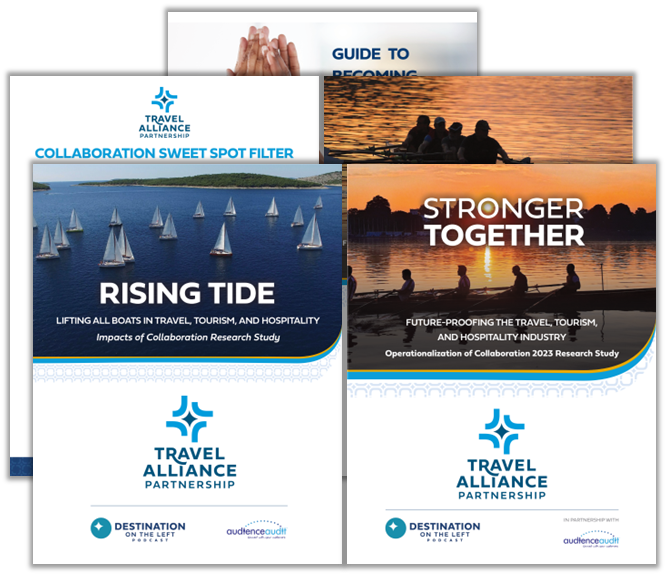
Our first research study confirmed that collaboration is a constant in the travel, tourism and hospitality industry. It is not a matter of if, but when and how, organizations will collaborate together. Our latest study reveals how organizations are putting collaboration into operation and how they are setting up systems and processes so that collaboration becomes a strategic part of the organization.
"*" indicates required fields