How to Build a Team Culture that Supports Collaboration
A collaborative organization starts with a collaborative mindset. If we want our organizations to benefit from collaboration, we can’t rely on the CEO, executive director or business development team to be the only people looking for opportunities. We need to create cultures where people throughout the organization think collaboratively.
That means our team members recognize when another organization could help us solve a problem, reach a new audience or create something we couldn’t accomplish on our own. They are empowered to build relationships outside of our four walls and when an opportunity emerges, they understand how to evaluate it, bring it forward and help execute it successfully.
That kind of culture doesn’t happen accidentally.
Our research into the operationalization of collaboration shows that while almost all organizations say collaboration is part of their business strategy, only 45% have actually documented it in their strategy. And only 15% say they have fully operationalized collaboration within their organization.
That gap represents a significant opportunity. If collaboration is truly part of your strategy, your team needs more than permission to collaborate. They need the mindset, tools and processes to do it well.
Make Collaboration Part of the Business Strategy
The first step is making sure your team understands that collaboration is not something extra, it is part of how you achieve your business goals.
Our operationalizing collaboration research found that organizations incorporate collaboration into their strategy for very practical reasons.
- 64% said collaboration increases value for their customers
- 58% said collaborations align with their mission, vision and values
- 49% see collaboration as a way to remain agile when changes hit the industry
This gives leaders an important place to start: make collaboration part of your strategy discussions.
- If you are trying to reach a new audience, ask: “Who already has a relationship with that audience?”
- If you are developing a new travel product or experience, ask: “Who could make this idea stronger?”
- If you are facing a challenge, ask: “Who else is trying to solve the same problem?”
- If you have a big goal, ask: “Could we accomplish more if we didn’t try to do this alone?”
The more frequently leaders ask those questions, the more likely employees are to start asking them too. Eventually, collaboration becomes a lens through which your team sees opportunity.
Give Your Team Permission to Look Outside the Organization
One of the most important shifts leaders can make is expanding who is responsible for collaboration. Our research found that marketing and business development are the departments most commonly involved in external collaborations, followed closely by leadership. About one-third of respondents said leadership owns collaboration, while another third said ownership depends on the collaboration.
I like that second approach. Collaboration does not always need to originate at the top. Opportunities and perspectives open up when anyone on a team can take start the conversation.
For example:
- Someone on your marketing team may see an opportunity with another destination.
- A salesperson may discover that two organizations are talking to the same customer.
- Someone working directly with visitors may hear about a need that three businesses could solve together.
Empowering Collaborative Ideas
Those observations are valuable. But employees need to know what to do with them. Create an environment where team members are encouraged to say, “I think there might be an opportunity for us to work with…” Then make sure there is a path for that idea to move forward.
Who should they talk to? What information should they gather? What makes an opportunity worth pursuing? Who can authorize the next conversation? If every collaboration idea has to wait until someone in leadership discovers it themselves, you are leaving a lot of opportunities on the table.
What an Outward-Looking Culture Looks Like
Sean McCarron, General Manager of Conrad Orlando, gave me a great example of what this looks like in practice when I interviewed him on Destination on the Left Episode #432, Building a Magnetic Resort Culture.
Sean has been intentional about creating a culture where employees throughout the resort have a voice. He holds monthly meetings with line-level representatives from every department—not managers or supervisors—and asks them to bring forward what they are seeing, hearing and thinking. The goal is to surface ideas that can improve both the guest and team member experience.
That mindset extends beyond the walls of the resort. Conrad Orlando has developed partnerships with Gatorland that introduce young guests to Florida wildlife and encourage them to explore the attraction; with retailers from Mall at Millenia that create pop-up experiences for resort guests; and with local nonprofits through programs that combine corporate group experiences with giving back to the community.
What I find most interesting about Sean’s example isn’t any one partnership. It’s that he created an environment that allows those partnerships to emerge.
“As the entire market in Orlando gets activated…and gets exposure, the better off we both are.” — Sean McCarron, General Manager, Conrad Orlando
That is the kind of thinking we want to encourage. When employees understand the organization’s goals, are encouraged to think creatively about the customer experience, and have permission to bring ideas forward, they naturally begin looking beyond the organization itself. “Who else could help us make this experience better?” That is the question we want our teams asking.
Teach People What a Good Collaboration Looks Like
Empowering people to find collaborations does not mean saying yes to every partnership that comes along. Building a culture that supports collaboration requires teaching people to recognize the difference between an interesting idea and a strategically valuable collaboration.
TAP’s Collaboration Assessment encourages organizations to develop processes for proactively researching potential collaborators, making a wish list of partners, and establishing a vetting process for new opportunities.
The research tells us what teams should be looking for. Two-thirds of respondents said they evaluate potential collaborators based on common goals and shared values. Organizations also consider customers in common, community standing and industry reputation. Yet only 28% of respondents said they had established a process for vetting potential collaborators.
Help Your Team Evaluate the Fit
That means there is another opportunity to make collaboration more intentional. Give your team a simple framework for evaluating an idea:
- What are we trying to accomplish?
- What does the potential partner bring to the table?
- What do we bring?
- Do we share a goal, audience, challenge or vision?
- Does this opportunity align with our mission, vision and values?
- Will everyone involved gain something meaningful from participating?
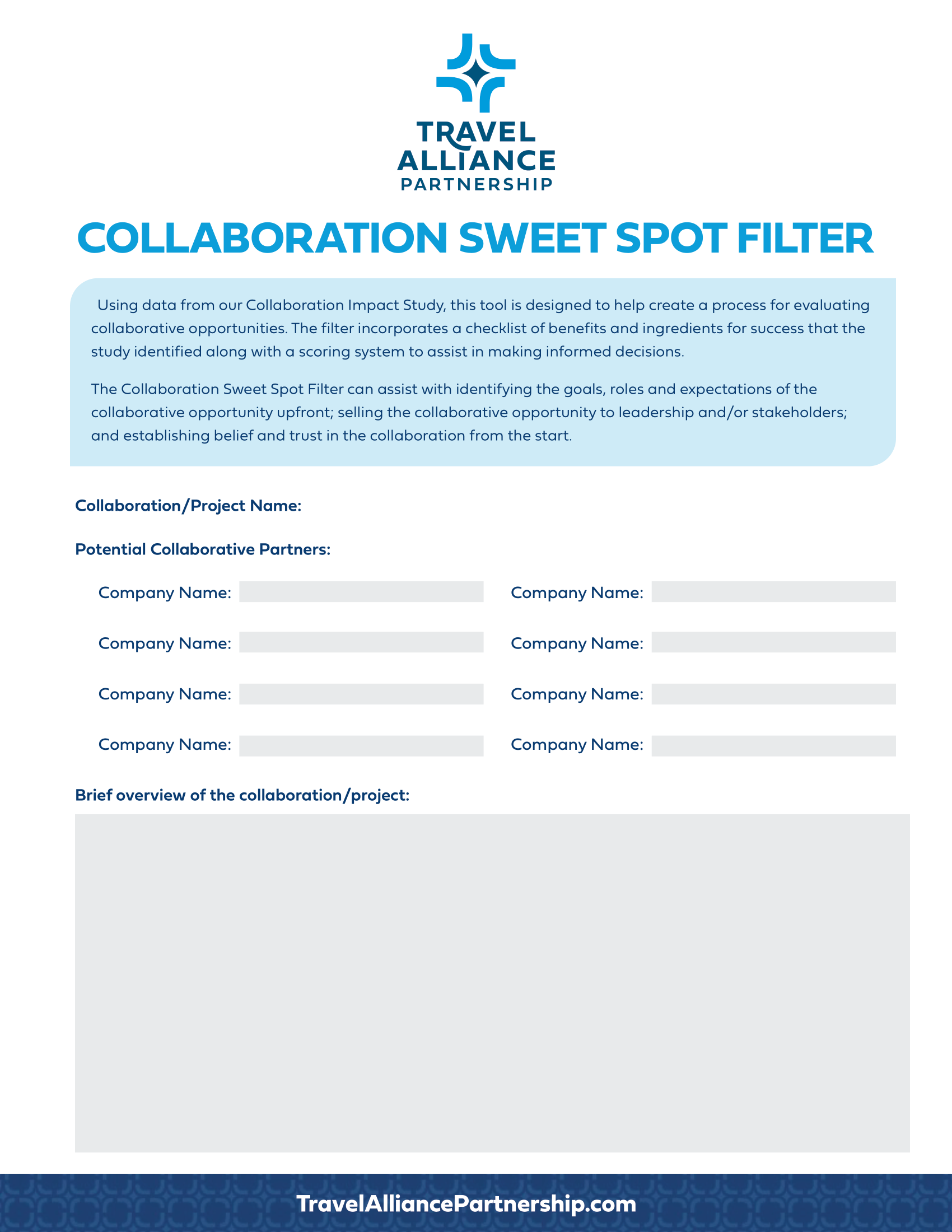
Our Collaboration Sweet Spot Filter takes this thinking one step further by looking at both the potential benefits of a collaboration and the ingredients for success. This is a good place to start helping your team members evaluate partnerships. Feel free to adapt it for your organization.
Give Collaboration Some Infrastructure
Once you encourage more people to look for collaboration opportunities, you also must give them the ability to execute. This is where operationalization comes in.
You don’t need a complicated collaboration manual, but your team should know the basics. The Guide to Becoming a Better Collaborator recommends having conversations at the beginning about roles, goals, expectations, concerns, boundaries and expected results and then creating regular checkpoints throughout the collaboration.
The 3 Types of Collaborators
It also means recognizing that people approach collaboration differently. Our earlier collaboration research identified three types of collaborators: Promoters, Doubters and Protectors. Promoters tend to jump enthusiastically into collaboration. Doubters bring healthy skepticism and want clearly defined goals and expectations. Protectors believe in collaboration but are more cautious about what they share and want clear boundaries.
All of these perspectives bring value to a collaboration. In fact, one of the most important things leaders can do is stop expecting everyone to collaborate in exactly the same way. A Promoter might generate energy and momentum while the Doubter might identify a risk no one else considered and the Protector might help the group establish boundaries that are best set from the start.
A collaborative culture values all three.
Reward People for Thinking Collaboratively
Finally, pay attention to what you celebrate. If we tell employees to collaborate but only reward individual accomplishments, we are sending two different messages.
Recognize the person who saw an opportunity and brought it forward. Share stories of partnerships that helped the organization reach a new customer, solve a problem or stretch limited resources. Talk about the collaborations that didn’t work too, and what the organization learned from them.
Our operationalization research found significant benefits for organizations that make collaboration part of the way they operate:
- 65% cited increased visitors or customers
- 64% cited stronger relationships with existing collaborators
- 58% saw increased opportunities for additional collaborations
- 56% reported an improved industry reputation
- 54% identified a competitive advantage
There is a reinforcing effect here. The more your organization collaborates successfully, the more people see your organization as a good collaborator. More opportunities appear. Your team gains more experience. Your network grows and identifying the next opportunity becomes easier.
That is what a culture that supports collaboration looks like. It is an organization filled with people who naturally look beyond its walls and ask: “Who could we work with to make this bigger, stronger or more impactful?”
When your whole team starts asking that question, collaboration stops being a leadership initiative. It becomes part of how your organization does business.
Related Posts
From Transactional to Transformational: Rethinking Partnerships
Partnership is one of those words we use a lot in the travel and tourism industry. We have marketing partners. Community partners. Funding partners. Industry partners….
How Agritourism Is Creating Meaningful Connections Through Food, Farm, and Place
There is something powerful about pulling a carrot from the ground, tasting a berry where it was grown or sitting down to a meal surrounded…
Collaboration Toolkit
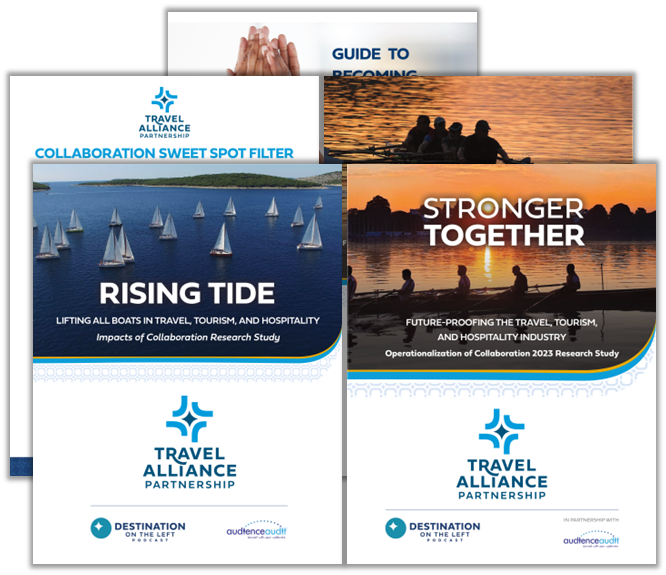
Our first research study confirmed that collaboration is a constant in the travel, tourism and hospitality industry. It is not a matter of if, but when and how, organizations will collaborate together. Our latest study reveals how organizations are putting collaboration into operation and how they are setting up systems and processes so that collaboration becomes a strategic part of the organization.
"*" indicates required fields