How Meeting Planners Are Choosing Destinations Today
There was a time when selecting a meeting destination felt largely logical. Today, it feels personal.
Planning meetings has always required balancing budgets, logistics and expectations. What feels different now is the weight of those decisions. Meeting planners are navigating rising costs, political sensitivities, safety concerns and sustainability expectations all at once. All while still being asked to deliver experiences that feel thoughtful and engaging.
Insights we gained from a recent Meeting Planners Webinar hosted by Future Partners, Miles Partnership and Informa Connect suggest the industry is not simply adjusting. It is recalibrating. Risk, relevance and relationships are still key considerations, but they are being redefined in real time, and the way destinations show up in the process matters more than ever.
Risk Has Become the Baseline for Meeting Planners
Safety is now an “everywhere” issue
Safety is no longer a secondary consideration. Sixty-five percent of planners expect safety concerns to increase, and many no longer view safety as something tied to a specific place. It is now considered an everywhere issue across the United States.
More than 60% of planners have already reconsidered a destination in 2025 due to political or controversial issues. In this environment, uncertainty matters. When planners do not clearly understand a destination, they tend to fill in the gaps themselves, often with assumptions that work against the destination.
At the same time, planners are becoming more structured in how they evaluate and prepare for that uncertainty. At sessions from the MPI New England Educational Institute, frameworks such as the Robinson Risk Management Model highlight a more proactive approach, encouraging planners to map out potential risks across categories like safety, technology, logistics and reputations, then assess them based on likelihood and impact. This shift reflects a broader mindset: risk is no longer something to avoid, but something to actively plan for.
Confidence matters more than perfection
What planners are looking for is not perfection, but confidence. Peer testimonials and direct conversations with DMO representatives continue to be the most trusted sources of reassurance.
Relevance Is Being Rewritten
Rising complexity is shaping destination choices
Budgets are increasing, but that does not mean planning has become easier. Rising costs, tariffs, labor challenges and sustainability expectations have made every decision more visible and more scrutinized.
Green practices are assumed rather than celebrated. Sustainability has moved from a headline to a given. It is simply part of doing business now.
In practice, this shift is showing up in more operational ways. At events like the Greenbuild International Conference, organizers have implemented food waste audits, donation programs and real-time tracking to reduce excess and better understand consumption patterns.
As highlighted by sustainability expert Dr. Aurora Dawn Benton, strategies such as pre-event food audits, adjusted portion planning and partnerships with local food recovery organizations are helping planners move beyond intention and into measurable impact, turning sustainability into an operational standard rather than a marketing message.
Reliability and transparency are becoming differentiators
At the same time, concerns around hotel strikes and operational disruptions have made reliability and transparency more valuable than novelty alone.
Relevance today is being defined by how well a destination supports planners through complexity, not by how loudly it markets itself.
Why Meeting Planners Are Expanding Their Shortlists
Interest in second and third-tier destinations has grown significantly, driven by the desire for new experiences, perceived safer environments and better overall value.
For many planners, lesser-known cities now represent flexibility and opportunity. For these emerging destinations, clear storytelling plays an increasingly important role as planners expand their consideration sets.
Technology Is Accelerating Curiosity, Not Replacing Trust
Immersive tools are entering early planning stages
Planners are finding themselves experimenting with immersive tools such as AR and VR to explore destinations earlier in the RFP process.
Nearly 70% are also turning to AI for destination inspiration, particularly when sourcing unique offsite experiences.
At the same time, AI is increasingly being used as a practical “co-pilot” in the planning process. At a recent MPI New Jersey industry session, one speaker noted that planners are using AI to draft agendas, summarize notes, brainstorm event concepts and support marketing content, freeing up time to focus on more strategic and creative decisions.
Human relationships still close the deal
Technology helps planners narrow options and generate ideas, but trust is still built through human connection.
AI can support decision making, but it does not replace conversations or reassurance.
Relationships Are the Constant
DMOs remain essential partners
One thing is clear: the role of the DMO is essential. Ninety-two percent of planners who worked with a DMO rated their experience as better, underscoring the value of partnerships during uncertain times.
At the same time, the expectations of what that partnership looks like are evolving. Increasingly, DMOs are being challenged to think beyond driving visitation and instead focus on shaping the long-term health and functionality of the destination itself, aligning more closely with economic development, community stakeholders and infrastructure planning.
Meeting planners are not just choosing destinations. They are choosing how much confidence, clarity and support they will have throughout the entire planning process.
Risk, relevance and relationships now move together, shaping how destinations are perceived and trusted.
From promotion to partnership
As the industry continues to shift, destinations are being challenged to think differently about how they show up. Promotion alone is no longer enough. Place needs to be paired with purpose, and marketing must accommodate partnership.
In an upcoming blog, we’ll cover part 2 of this series about meeting planners, and explore how destinations are translating these expectations into action by promoting place, purpose and partnership in more intentional ways.
Related Posts
Making a Splash: How to Maximize Reach for Your Brand at a Tourism Conference
For tourism and hospitality businesses, a conference is a perfect place to make a splash when launching a new brand or a major announcement. When…
Lessons Learned from a Branding Journey: Insights from Our Company’s Transformation
I am excited to share the story of our company’s recent branding journey, offering valuable insights and lessons learned along the way. As we unveil…
Collaboration Toolkit
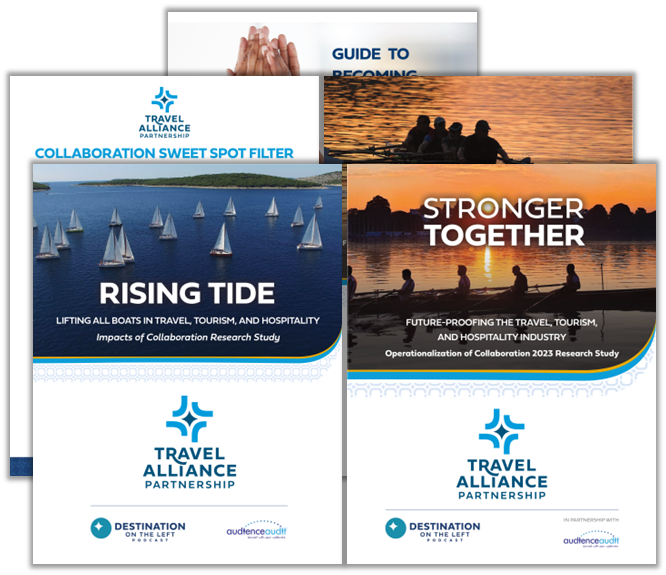
Our first research study confirmed that collaboration is a constant in the travel, tourism and hospitality industry. It is not a matter of if, but when and how, organizations will collaborate together. Our latest study reveals how organizations are putting collaboration into operation and how they are setting up systems and processes so that collaboration becomes a strategic part of the organization.
"*" indicates required fields