Tourism Advocacy: How Stronger Partnerships Build Stronger Communities
Tourism advocacy often brings to mind meetings with elected officials, legislative priorities, and policy discussions. While those efforts are important, they’re only one piece of the picture. The strongest advocates for tourism aren’t simply asking for support when a challenge arises—they’re building relationships every day with residents, businesses, nonprofit organizations, community leaders, and industry partners.
That broader view of tourism advocacy emerged as a central theme during a recent TAP Community Conversation, where leaders from destination organizations, an attraction, and a national transportation association shared how advocacy has evolved within their organizations. Although each panelist approached the topic from a different perspective, they arrived at a common conclusion: meaningful advocacy begins with trust, grows through collaboration, and succeeds when the entire community understands tourism’s value.
Tourism Advocacy Is Bigger Than Government Relations
Advocacy has long been associated with influencing public policy, but today’s tourism professionals are redefining what it means to champion their destinations. Rather than focusing solely on legislative priorities, they’re investing in relationships that strengthen their communities and create lasting support for tourism.
Whether working with elected officials, local businesses, community organizations, or fellow tourism professionals, collaboration is the key to successful tourism advocacy. It creates opportunities to build mutual understanding and uncover solutions that benefit everyone.
Our panelists echoed this philosophy throughout the discussion.
- Patrick Kaler, President and CEO of Visit Buffalo, described advocacy as a continuous effort to demonstrate tourism’s role as an economic driver.
- Tony Snell Rodriguez, Director of Community Engagement and Inclusion at Visit Milwaukee, emphasized that advocacy begins by listening to residents.
- Steven Coyle, Director of Government Relations for Transportation Policy at the American Bus Association, shared how industry advocacy gives hundreds of small businesses a stronger collective voice.
- Hillarie Logan-Dechene, Deputy Director of The Wild Center, explained how museums and attractions can advocate not only for themselves but for the broader destinations they help shape.
Together, their experiences reveal an important shift: tourism advocacy is no longer something organizations do only when legislation is on the table. It’s an ongoing commitment to building understanding, trust, and shared purpose.
Build Relationships Before You Need Support
The most effective advocacy begins with a relationship.
For Visit Milwaukee, that means spending time with neighborhood organizations, chambers of commerce, nonprofit leaders, cultural groups, and residents long before asking for their support. Tony Snell Rodriguez described community roundtables and listening sessions that help his organization understand local priorities while giving residents an opportunity to shape the stories visitors hear about the city.
Listening Creates Better Advocates
Instead of assuming what communities need, organizations are creating opportunities to listen first and collaborate second. When residents feel heard, they’re far more likely to become ambassadors for the places they call home.
Hillarie Logan-Dechene shared a similar perspective from her work at The Wild Center. Drawing on her background in fundraising, she explained that authentic relationships are the foundation of successful philanthropy, and the same principle applies to tourism advocacy. Strong partnerships develop when organizations invest time in getting to know one another, understanding shared goals, and recognizing that everyone contributes to a destination’s success.
Patrick Kaler reinforced this mindset by noting that advocacy “never stops.” Building relationships with local officials, statewide organizations, national associations, and community partners creates a network of trust that becomes invaluable when opportunities—or challenges—arise.
Make Tourism’s Value Personal
Tourism professionals have no shortage of data. Economic impact reports, visitor spending, tax revenue, and employment statistics all help demonstrate tourism’s importance. The challenge is making those numbers meaningful.
Throughout the discussion, panelists emphasized that effective tourism advocacy connects statistics to real people.
Turn Economic Data into Human Stories
Patrick Kaler shared how Visit Buffalo Niagara framed the case for a new convention center by moving beyond construction costs and focusing instead on the jobs, visitor spending, and local businesses that would benefit. Rather than presenting abstract figures, the organization demonstrated what those investments meant for families, employers, and the community’s long-term economic competitiveness.
Steven Coyle offered another example through the American Bus Association. When bus operators in New York City began facing operational challenges from local idling regulations, the association quickly gathered data from its members to understand the broader impact. That research revealed that many operators were already reducing service, giving the organization credible evidence to engage lawmakers while also helping hotels, restaurants, and attractions understand how transportation policy could affect visitor access.
Whether it’s a florist serving convention attendees, a neighborhood restaurant welcoming tour groups, or residents benefiting from visitor-generated tax revenue, personal stories help audiences understand why tourism matters. Statistics establish credibility, but stories create connection.
The Strongest Tourism Advocacy Happens Across Sectors
One of the most valuable lessons from the discussion was that some of tourism’s strongest advocates may not work in tourism at all.
Patrick Kaler encouraged organizations to broaden the voices involved in advocacy efforts. Instead of asking only hotel owners or destination organizations to champion tourism investments, consider inviting healthcare leaders, university presidents, economic development organizations, or small business owners to share how visitors contribute to their communities. Their perspectives often carry additional credibility because they demonstrate tourism’s influence beyond the visitor economy itself.
Finding Innovative Partners Beyond Tourism
Tony Snell Rodriguez described partnerships that connect conventions with local nonprofit organizations, allowing visiting groups to leave meaningful legacies in the community. He also shared a creative collaboration among Visit Milwaukee, Adidas, Summerfest, and local entrepreneur Eric “Shake” James to create a sneaker celebrating Milwaukee’s 191 neighborhoods. The project strengthened resident pride while giving visitors another authentic way to connect with the destination.
Collaboration doesn’t always require long-term commitments. Hillarie Logan-Dechene offered one of the discussion’s most memorable observations: organizations should think about partnerships as “a lot of dating, not a lot of marrying.” Short-term collaborations with local breweries, artists, community groups, or businesses can create fresh experiences while allowing organizations to explore new ideas without significant risk.
These examples illustrate how tourism advocacy becomes stronger when it reflects an entire community, rather than a single industry.
Creating a Culture of Tourism Advocacy
Advocacy requires consistency. Communities are more likely to support tourism when they see organizations contributing to local priorities year-round instead of appearing only when funding or policy decisions are on the agenda.
Everyone Has a Role to Play
Tourism advocacy isn’t reserved for CEOs, government affairs professionals, or destination marketing organizations. Every organization that benefits from visitors has a role in helping others understand tourism’s value.
That starts with building genuine relationships before they’re needed. It means listening to community priorities, inviting new voices into conversations, sharing stories that make economic impact tangible, and seeking partnerships that strengthen entire destinations rather than individual organizations.
When attractions, transportation providers, destination organizations, businesses, nonprofits, residents, and public leaders work together, tourism becomes more than an industry. It becomes a shared investment in the future of the community.
Author
Related Posts
Workforce Development Is Everyone’s Job
Since I have been working in the tourism industry, workforce development has been part of the conversation. Earlier in my career, much of the focus…
Loretripping: Turning Local Stories Into Travel Motivation
Travelers have always been drawn to the stories behind a place: the legend tied to an old inn, the trailblazer who once called a community…
Collaboration Toolkit
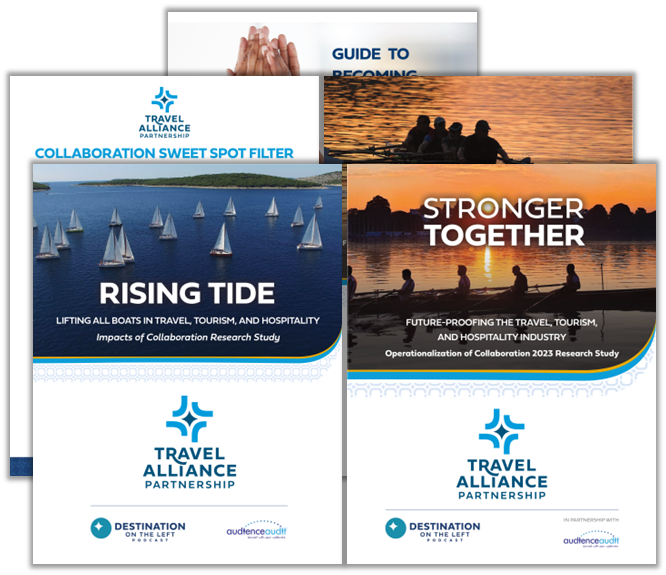
Our first research study confirmed that collaboration is a constant in the travel, tourism and hospitality industry. It is not a matter of if, but when and how, organizations will collaborate together. Our latest study reveals how organizations are putting collaboration into operation and how they are setting up systems and processes so that collaboration becomes a strategic part of the organization.
"*" indicates required fields