Why Collaboration Is No Longer Optional in Travel and Tourism
For years, collaboration has been an essential part of travel and tourism. In an industry that requires destinations, attractions, lodging and tour operators to work together to create travel product people will buy, collaboration simply happened naturally.
What I have come to learn through my research is that the most successful collaborations have relied on a mix of strategy and soft human skills. They didn’t happen by accident or as an afterthought. Collaboration has long been a best-practice for organizations in travel and tourism; now, it is becoming something even more fundamental.
Collaboration is no longer a tactical approach to marketing or partnership development. It is a strategic imperative.
This shift is not happening in isolation within our industry. It reflects broader global trends that are reshaping how organizations, communities, and economies function. When viewed through that lens, collaboration is not simply a way to enhance what we do; it is becoming essential to how we operate.
A Global Shift in Trust and Connection
To understand why collaboration matters more now than ever, it is helpful to look beyond our industry.
The Edelman Trust Barometer, now in its 26th year, offers a clear picture of how trust is evolving across society. The study, which spans 28 countries and more than 33,000 respondents, shows a continued decline in trust in traditional institutions such as government, media, and non-profits. At the same time, trust is becoming more localized; centered on employers, colleagues, and personal relationships.
A More Insular World
One of the most striking findings is the growing sense of insularity. A significant majority of respondents report hesitancy to trust people who are different from themselves. This signals a broader shift in how people engage with the world: more cautiously, more defensively, and with a higher bar for trust.
In practical terms, this means that individuals are bringing these perceptions into every interaction—whether they are engaging with a brand, visiting a destination, or participating in a community. The expectation that organizations will “earn” trust has never been higher.
At the same time, Edelman’s research introduces the idea that businesses are now expected to play a more active role in addressing this gap. As one of the most trusted institutions, employers and organizations are increasingly seen as responsible for helping to rebuild trust and bring people together.
Tourism’s Role in a More Fragmented World
Within this context, the travel and tourism industry occupies a unique position.
A recent World Economic Forum article highlights tourism as more than an economic driver. It identifies the sector as a stabilizing force in a polarized world. One that supports economic resilience, strengthens local communities, and fosters cross-cultural understanding. The impact is not abstract; a significant portion of tourism’s economic activity directly benefits small and mid-sized businesses and the communities they serve.
A Naturally Connective Industry
This perspective reinforces something many of us in the industry have long understood: tourism is inherently connective. It brings together stakeholders with different priorities, perspectives, and goals, and aligns them around a shared outcome.
As the World Economic Forum notes, the ability to create shared value across diverse groups is not just beneficial—it is essential in an increasingly complex global environment.
Collaboration Has Always Been Part of Tourism’s DNA
Long before collaboration became a topic of global discussion, it was embedded in how tourism operates.
The concept of “co-opetition”—cooperation among competitors—is a familiar one in our industry. Destinations, businesses, and organizations regularly work together to create experiences and outcomes that no single entity could achieve on its own. This ability to balance shared goals with individual interests is not incidental; it is a defining characteristic of how the industry functions.
A Model for Other Sectors
Global research is now reinforcing this approach. Insights from the Global Cooperation Barometer and conversations emerging from the World Economic Forum point to the same conclusion: cooperation and competition are not opposing forces. They are complementary, and both are necessary for progress.
In other words, what has long been standard practice in tourism is now recognized as a model for other sectors.
From Human Strengths to Organizational Strategy
While collaboration is deeply ingrained in the industry, there is an important distinction between how individuals collaborate and how organizations support that collaboration.
In a research study I commissioned on collaboration in the tourism industry, we found that the most effective collaborators consistently demonstrate a common set of qualities:
- Communication
- Open-mindedness
- Flexibility
- Active listening
- A willingness to work as part of a team.
These are not complex or technical skills. They are fundamentally human.
The Organizational Gap
However, the presence of these qualities at an individual level does not automatically translate into organizational success. In many cases, collaboration remains informal, relationship-driven, and inconsistent. It depends on the initiative of individuals rather than support by defined processes or alignment with broader strategic goals.
This creates a gap.
Organizations recognize the value of collaboration but often lack the structure to execute it in a consistent and scalable way.
The Case for Operationalizing Collaboration
If collaboration is essential to achieving outcomes such as economic growth, community impact, and innovation, then it must be integrated into the core of how an organization operates. It requires alignment with annual business planning, clarity around shared goals, and the development of repeatable processes that support partnership development and execution.
Without this level of intentionality, collaboration remains reactive. It is pursued when opportunities arise, rather than being leveraged as a proactive strategy.
This distinction is critical. When collaboration is embedded into organizational strategy, it becomes a driver of long-term value rather than a source of short-term activity.
A Strategic Imperative for the Future
The convergence of these trends—declining institutional trust, increasing global complexity, and the recognition of tourism’s role in fostering connection—points to a clear conclusion.
Collaboration is no longer optional in travel and tourism. It is foundational to how progress will be made.
For leaders across destinations, economic development organizations, and the private sector, this represents both a challenge and an opportunity. It requires a shift in mindset, from viewing collaboration as supportive to viewing it as central.
It also calls for a more deliberate approach: one that aligns collaboration with business objectives, invests in the skills and systems needed to support it, and measures its impact over time.
Moving Forward with Intention
The tourism industry is well-positioned to lead in this space. It has long demonstrated the ability to bring people together, to align diverse interests, and to create shared value across communities.
The next step is to build on that foundation.
By approaching collaboration as a strategic function—one that is planned, supported, and operationalized—organizations can move beyond isolated successes and begin to realize its full potential.
In a world that is increasingly divided, the ability to work together effectively is not just a competitive advantage. It is a necessary condition for growth, resilience, and long-term success.
Author
Related Posts
How to Turn Destination Stewardship Into a Visitor Experience
When we discuss destination stewardship, it often starts behind the scenes, with a focus on protecting natural resources, preserving cultural traditions, supporting residents, and thinking…
The Collaborative Mindset: Five Traits That Drive Better Partnerships
Every leader I meet agrees that collaboration is important. It’s written into strategic plans, highlighted in mission statements, and celebrated in annual reports. Organizations proudly point…
Collaboration Toolkit
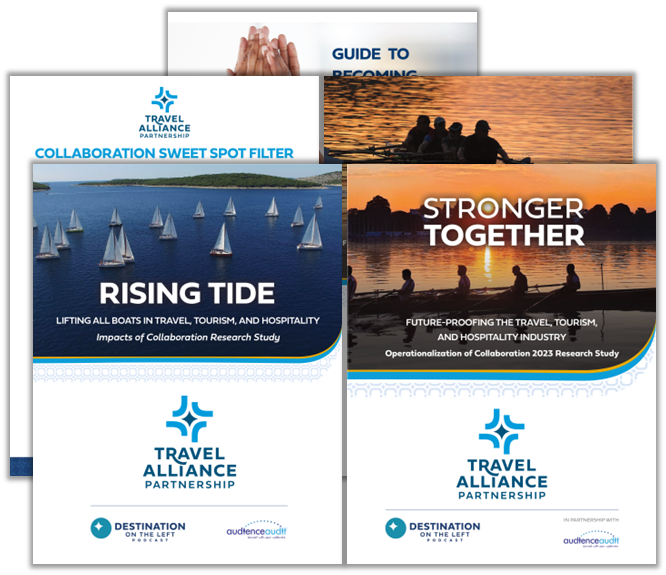
Our first research study confirmed that collaboration is a constant in the travel, tourism and hospitality industry. It is not a matter of if, but when and how, organizations will collaborate together. Our latest study reveals how organizations are putting collaboration into operation and how they are setting up systems and processes so that collaboration becomes a strategic part of the organization.
"*" indicates required fields