How to Move Your Organization from Reactive to Proactive Collaboration
In 2016, I launched my podcast Destination on the Left to explore creativity and collaboration in the travel and tourism industry. At the time, I noticed collaboration was happening naturally across the industry, but many organizations treated it as incidental rather than strategic.
Partnerships formed because of relationships, immediate opportunities, or shared projects but rarely because collaboration had been intentionally built into the organization’s long-term strategy.
In other words, most organizations were taking a reactive approach to collaboration rather than a proactive one.
Over the past decade, I have continued studying what makes collaborations successful, what gets in the way, and why some organizations seem to create stronger partnership outcomes than others. One of the most significant findings from our research on the operationalization of collaboration was:
Only 15% of organizations have fully operationalized collaboration within their organization.
That finding raises an important question:
If nearly everyone agrees collaboration is valuable, why are so few organizations approaching it strategically?
Understanding Different Collaboration Mindsets
In 2023, we expanded our research to better understand how organizations operationalize collaboration in practice. We wanted to explore not only the systems and processes organizations use, but also how attitudes and beliefs shape their approach to partnerships.
What emerged were three distinct collaboration operating segments: Prudent Planners, Enterprisers, and Selective Spectators.
Each reflects a different mindset toward collaboration and reveals important insights into how organizations approach partnership development, planning, and execution.
Prudent Planners: Structure Creates Confidence
Prudent Planners represent approximately 35% of respondents and tend to believe that successful collaboration requires clearly defined objectives, formal processes, and careful planning.
These organizations are more likely to integrate collaboration into annual budgeting and operational planning. They value contingency planning and believe formalizing collaboration processes improves outcomes.
What stands out about this group is their belief that collaboration should not be left to chance. They view partnerships as something that deserves the same level of operational rigor as any other strategic initiative. Their approach reinforces an important point: organizations are far more likely to prioritize collaboration when it is intentionally built into planning and resource allocation.
Enterprisers: Flexible, Strategic, and Opportunity-Focused
Enterprisers, who make up roughly 32% of respondents, take a different approach.
While they also see collaboration as a competitive advantage, they tend to be more flexible in how they execute partnerships. Rather than relying on rigid systems, they adapt their process depending on the collaborator and opportunity.
What makes this segment especially interesting is that they consistently connect collaboration to broader business strategy and long-term organizational success.
Enterprisers are more likely to:
- view collaboration as a competitive advantage
- proactively plan for multi-organization partnerships
- emphasize leadership involvement
- seek opportunities outside their immediate industry
They also strongly believe successful collaborations require a collaborative mindset focused on the end customer.
Not surprisingly, Enterprisers were statistically more likely to hold executive leadership roles and work within destination marketing organizations, where collaboration is often central to daily operations.
Their perspective reinforces something I have seen repeatedly throughout the industry: organizations that approach collaboration strategically tend to see greater long-term value from it.
Selective Spectators: Interested, But Hesitant
Selective Spectators, representing just over 32% of respondents, tend to approach collaboration more cautiously.
These organizations often prefer others to take the lead and are more hesitant about investing significant time and resources into partnership planning. Many expressed concerns that collaboration can become cumbersome or difficult to manage effectively.
Interestingly, this group was also more likely to feel their organization was not approaching collaboration as effectively as it could.
This matters because hesitation often creates a cycle:
- Organizations wait for opportunities rather than proactively pursuing them
- Collaboration remains reactive
- Partnerships fail to generate their full potential value
Without clear systems and strategic alignment, collaboration can begin to feel more complicated than beneficial.
What All Successful Collaborators Agree On
Despite their differences, respondents across all three segments shared several important beliefs.
Most agreed that:
- successful collaborations require a collaborative mindset
- leadership involvement is essential
- organizations that fail to plan for collaboration risk wasting both time and money
- finding customers in common is one of the best ways to identify strong collaborators
One finding stood out above the rest: 87% of respondents agreed that open-mindedness is essential to successful collaboration.
That statistic reinforces something I have observed throughout my years of interviewing leaders across the tourism industry. Collaboration is not driven solely by systems or strategy. It is also driven by human qualities—communication, flexibility, active listening, and a willingness to work toward shared outcomes.
As Carol Dweck writes in Mindset: The New Psychology of Success: “Mindsets change what people strive for and what they see as success.”
The organizations seeing the greatest success with collaboration are not simply forming more partnerships. They are creating cultures and operational strategies that support collaboration intentionally and consistently.
Moving from Reactive to Proactive Collaboration
One of the biggest lessons from this research is that collaboration cannot remain informal if organizations want to maximize its impact.
Reactive collaboration happens when organizations pursue partnerships only when opportunities appear. Proactive collaboration happens when partnership development is aligned with organizational strategy, operational planning, and long-term business goals.
That shift changes everything.
When collaboration becomes operationalized:
- teams have greater clarity around priorities
- partnerships align more closely with mission and values
- communication becomes more consistent
- organizations are better positioned to identify opportunities that create long-term value
As the saying goes, “where attention flows, energy grows.”
Organizations that intentionally prioritize collaboration create the conditions for stronger partnerships, greater innovation, and more sustainable success.
Assessing Your Organization’s Collaboration Strategy
If collaboration is truly a strategic priority, organizations need a way to evaluate how effectively they are operationalizing it.
That is why we developed our Collaboration Assessment Tool—to help organizations identify where they are already seeing success and where there may be opportunities to strengthen their approach. The assessment is designed to help leaders evaluate how collaboration shows up across planning, communication, leadership alignment, and operational strategy.
More importantly, it provides a framework for moving from reactive partnerships to a more intentional and proactive collaboration model.
Because collaboration is no longer something organizations can afford to approach casually.
The organizations that will thrive in the future are the ones that strategically embed collaboration into how they operate every day.
Related Posts
The Collaborative Mindset: Five Traits That Drive Better Partnerships
Every leader I meet agrees that collaboration is important. It’s written into strategic plans, highlighted in mission statements, and celebrated in annual reports. Organizations proudly point…
How to Find the Right Collaboration Partners
Collaboration is one of the most powerful tools available to tourism organizations. It can help stretch limited resources, spark new ideas, reach new audiences, solve…
Collaboration Toolkit
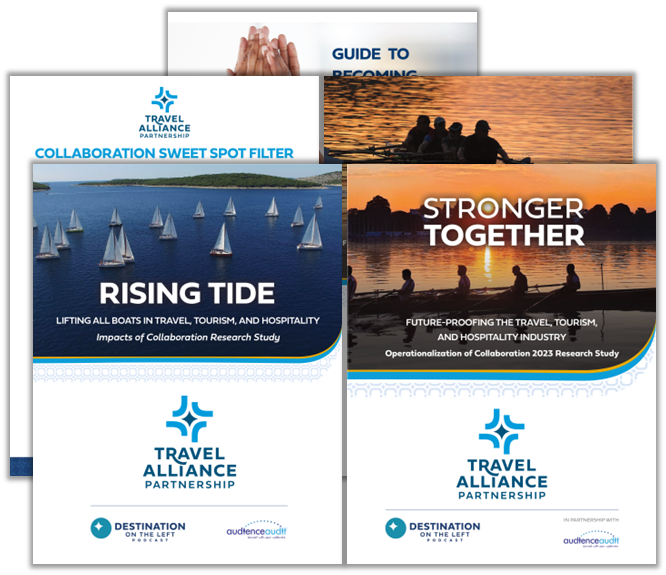
Our first research study confirmed that collaboration is a constant in the travel, tourism and hospitality industry. It is not a matter of if, but when and how, organizations will collaborate together. Our latest study reveals how organizations are putting collaboration into operation and how they are setting up systems and processes so that collaboration becomes a strategic part of the organization.
"*" indicates required fields