How to Find the Right Collaboration Partners
Collaboration is one of the most powerful tools available to tourism organizations. It can help stretch limited resources, spark new ideas, reach new audiences, solve shared challenges, and create outcomes that no single organization could accomplish alone.
But not every collaboration is the right collaboration.
Sometimes a potential partnership sounds exciting on the surface, only to become difficult once the work begins. Other times, an opportunity feels complicated at first, but with the right structure and shared commitment, it becomes a high-impact collaboration that delivers value for everyone involved.
The difference often comes down to the partnership evaluation, knowing how to evaluate the opportunity before you say yes.
At Travel Alliance Partnership, our work around collaboration has been shaped by years of interviews, client work, and formal research into what makes partnerships succeed. Through our Collaboration Impact Study, we identified the factors that show up again and again in effective collaborations. That research led to our 3-C Collaboration Framework: Communication, Commonality, and Commitment.
It also led us to create a practical tool: the Collaboration Sweet Spot Filter.
The Sweet Spot Filter is designed to help organizations evaluate collaborative opportunities with more intention. It provides a process for identifying the goals, roles, expectations, benefits, and ingredients for success before too much time, money, or political capital has been invested. It can also help build buy-in with leadership or stakeholders by giving structure to what can otherwise feel like a gut decision.
Partnership Evaluation Starts With the Opportunity
When organizations think about collaboration, they often start by asking, “Who should we partner with?”
That is an important question, but it may not be the best first question.
A better starting point is: What are we trying to accomplish?
Before you evaluate a potential partner, get clear on the collaboration itself.
- What is the project or opportunity?
- What problem are you solving?
- What outcome are you hoping to create?
- Who will benefit if this works?
The Collaboration Sweet Spot Filter begins with space to name the collaboration or project, identify potential partners, and provide a brief overview of the opportunity. That may sound simple, but this first step is important. If you cannot clearly explain the collaboration in a few sentences, it may be too vague to evaluate.
Clarity at the beginning prevents confusion later.
Look for Real Benefits
Evaluate the potential benefits of the collaboration. This matters because partnerships require energy. Even when everyone is excited, collaboration takes time, communication, compromise, and follow-through.
A good collaboration should create meaningful value.
Our research shows that collaborators receive many benefits such as increased innovation or fresh thinking, improved relevance to customers or stakeholders, economic value, stronger brand identity or reputation, expanded knowledge or skills, increased trust, operational efficiencies, improved organizational culture, or even employee satisfaction and retention.
This is a helpful reminder that collaboration is not just about marketing exposure or shared cost. Sometimes the greatest value of a partnership is learning something new, gaining credibility, strengthening relationships, or improving how your organization works.
For example, a destination marketing organization might partner with cultural attractions, restaurants, and lodging partners to create a new themed itinerary. The economic benefit may be increased visitation, but the collaboration may also improve community pride, strengthen cross-sector relationships, and position the destination around a more compelling visitor experience.
The strongest collaborations usually produce more than one kind of benefit.
Evaluate the Ingredients for Success
A potential collaboration can have strong benefits and still fail if the right structure is not in place.
That is why you should consider the ingredients for success through the lens of the 3-C Framework for Collaboration: Communication, Commonality, and Commitment.
Communication
Successful collaboration requires more than occasional check-ins. Partners need a shared vision, realistic expectations, a plan for communication, and clearly identified roles. These questions may seem obvious, but they are often skipped in the excitement of getting started.
When communication is weak, assumptions fill the gaps. One partner may think they are contributing strategy while another expects execution. One organization may assume weekly meetings are necessary while another expects updates only when milestones are reached.
Naming these expectations upfront reduces friction and creates a stronger foundation.
Commonality
Commonality is about shared purpose. Ask whether the collaboration benefits all partners, whether there are strong champions for the collaboration, and whether the goals are clearly identified.
This is where many collaborations either gain momentum or start to wobble.
- If one partner is carrying the work while another receives most of the benefit, resentment builds.
- If goals are too broad, partners may define success differently.
- If there is no internal champion, the collaboration may lose priority when things get busy.
The right partners do not need to be identical. In fact, collaborations are often strongest when partners bring different strengths, audiences, or perspectives. But they do need enough common ground to stay aligned.
Commitment
The third C is Commitment. This is the reality check. Ask whether accountability is in place, are leadership teams well-informed, whether all participants are fully committed, and whether the resources are available to see the collaboration through.
A collaboration can have a great idea, strong partners, and clear goals, but if no one has time, budget, authority, or accountability, it will struggle. Commitment means more than verbal enthusiasm. It means the collaboration has the resources and support it needs to move from idea to execution.
Use Scoring to Guide the Conversation
One of the most useful parts of the Collaboration Sweet Spot Filter is its scoring system. Each “yes” answer receives five points, for a total of 100 possible points. A score of 60 or above suggests the collaboration is likely to succeed and deserves thoughtful consideration. A score under 60 does not automatically mean the opportunity should be rejected. Instead, it points to areas that need more discussion.
The purpose of the filter is not to shut down opportunities. It is to make better decisions.
- If the score is low because roles are unclear, that can be fixed.
- If leadership is not yet informed, that conversation can happen.
- If goals are not identified, the partners can work together to define them.
The score gives you a starting point for a more productive conversation.
The Right Partner is the One Who Fits the Opportunity
You may or may not end up with a partner with the most recognizable name, the largest organization, or one with a large audience. Your focus needs to be on finding alignment between the opportunity, the benefits, and the conditions for success. Because the right partner brings value, shares purpose, communicates clearly, commits resources, and helps create an outcome that benefits everyone involved.
Use the Collaboration Sweet Spot Filter on your next collaboration to create a pause. The pause is however long you need to ask the right questions before saying yes. It can be the difference between a collaboration that drains time and one that creates lasting impact.
In an industry built on relationships, collaboration will always be essential. But the most successful partnerships are not accidental. They are intentional, structured, and grounded in shared value.
Author
Related Posts
The Collaborative Mindset: Five Traits That Drive Better Partnerships
Every leader I meet agrees that collaboration is important. It’s written into strategic plans, highlighted in mission statements, and celebrated in annual reports. Organizations proudly point…
How to Move Your Organization from Reactive to Proactive Collaboration
In 2016, I launched my podcast Destination on the Left to explore creativity and collaboration in the travel and tourism industry. At the time, I noticed collaboration…
Collaboration Toolkit
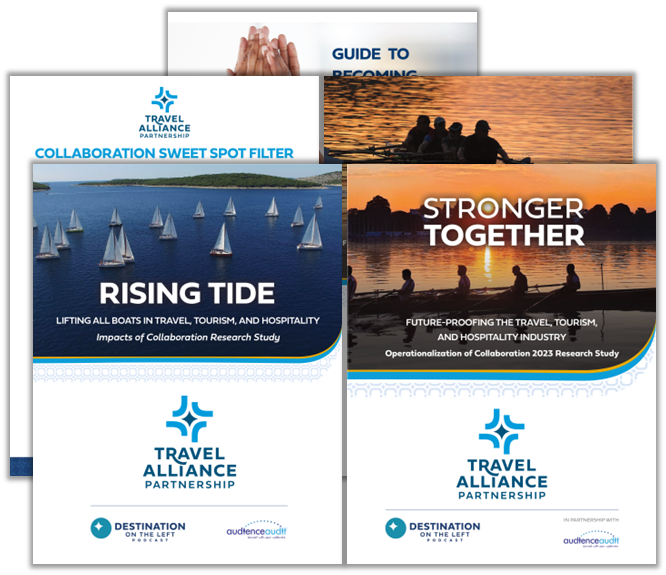
Our first research study confirmed that collaboration is a constant in the travel, tourism and hospitality industry. It is not a matter of if, but when and how, organizations will collaborate together. Our latest study reveals how organizations are putting collaboration into operation and how they are setting up systems and processes so that collaboration becomes a strategic part of the organization.
"*" indicates required fields