The Collaborative Mindset: Five Traits That Drive Better Partnerships
Every leader I meet agrees that collaboration is important.
It’s written into strategic plans, highlighted in mission statements, and celebrated in annual reports. Organizations proudly point to successful partnerships as evidence of their impact. Yet after nearly a decade of studying collaboration in the travel and tourism industry, I’ve noticed something interesting.
The organizations that consistently build meaningful, long-lasting partnerships don’t simply do collaboration better. Their leaders think about collaboration differently.
That’s because collaboration isn’t just something organizations do. It’s a way leaders think—and the foundation of a collaborative mindset.
Over the past ten years, I’ve explored this idea through hundreds of conversations with leaders on my podcast, Destination on the Left, and through original research on the operationalization of collaboration. While every collaboration is unique, one pattern continues to emerge: successful collaborative leaders share a common mindset. They approach relationships, decision-making, and problem-solving differently than leaders who view collaboration as merely another business tactic.
The encouraging news is that this mindset isn’t reserved for a select few. It isn’t determined by personality, title, or years of experience. It’s built through intentional behaviors that anyone can develop.
Our research identified five traits that consistently distinguish leaders who create stronger partnerships and more collaborative organizations: open-mindedness, communication, active listening, flexibility and adaptability, and a team-first mentality. Together, these traits form the foundation of what I call a collaborative mindset.
1. Open-Mindedness: Curiosity Before Certainty
If one finding from our research stood above all the others, it was this: 87% of respondents agreed that open-mindedness is essential to successful collaboration.
That level of agreement tells us something important. Successful collaboration begins long before organizations launch a joint initiative. It begins with a willingness to consider that another perspective may strengthen your own.
Open-minded leaders don’t enter partnerships believing they already have the best solution. They ask thoughtful questions, remain curious, and create space for new ideas to emerge. They recognize that innovation often happens when different experiences, perspectives, and expertise intersect.
Carol Dweck writes in Mindset, “Mindsets change what people strive for and what they see as success.” Collaborative leaders measure success not by whose idea wins, but by whether the partnership produces a better outcome than either organization could have achieved on their own.
Putting It Into Practice
- Replace one assumption this week with a genuine question.
- Invite perspectives from organizations outside your traditional network.
- In your next partnership meeting, spend more time exploring possibilities than defending positions.
2. Communication: Creating Alignment Through Clarity
Collaboration depends on communication, but not simply communication for the sake of sharing information. Effective collaborative leaders communicate with clarity, transparency, and consistency so that everyone understands the shared purpose.
Our research consistently identified communication as one of the strongest predictors of successful collaboration. Respondents also agreed that organizations that fail to plan and communicate effectively can lose both time and money.
When expectations aren’t clearly defined, misunderstandings grow. Partners begin making assumptions, priorities drift, and trust can erode. On the other hand, leaders who communicate openly create alignment around goals, responsibilities, timelines, and desired outcomes.
Strong communication isn’t about having all the answers. It’s about ensuring everyone is moving in the same direction.
Putting It Into Practice
- Begin every collaboration by defining what success looks like together.
- Create regular communication checkpoints rather than waiting for problems to arise.
- Share challenges early. Transparency builds trust.
3. Active Listening: Understanding Before Responding
Listening sounds simple, but it is one of the most overlooked leadership skills. Too often, leaders listen to prepare their response instead of listening to understand another perspective.
Active listening demonstrates respect. It helps uncover shared priorities, identify potential obstacles early, and build trust between organizations that may have different goals, resources, or cultures.
Our research found broad agreement that successful collaborations require a collaborative mindset. Listening is one of the clearest demonstrations of that mindset because it signals that every partner’s perspective has value.
Putting It Into Practice
- Ask one more follow-up question before offering your opinion.
- Reflect back what you heard before suggesting a solution.
- Focus on understanding the interests behind someone’s position, not just the position itself.
4. Flexibility and Adaptability: Meeting Partners Where They Are
No two collaborations are exactly alike.
One of the more interesting findings from our research came from what we called Enterprisers—leaders who view collaboration as a competitive advantage. Rather than applying the same process to every partnership, they adapt their approach depending on the opportunity and the organizations involved.
Flexibility doesn’t mean abandoning structure or lowering expectations. It means recognizing that successful partnerships require responsiveness.
Every collaborator brings different strengths, constraints, decision-making styles, and organizational cultures. Leaders with a collaborative mindset understand that forcing every partnership into the same template often limits its potential.
Adaptability allows collaborations to evolve while remaining focused on the shared outcome.
Putting It Into Practice
- Adjust your communication style to fit your collaborators.
- Revisit roles and expectations as projects evolve.
- Treat changes as opportunities to improve the partnership rather than disruptions to the plan.
5. A Team-First Mentality: Prioritizing Shared Success
Perhaps the most defining characteristic of collaborative leaders is how they define success. Transactional leaders often begin with the question, “What does my organization gain?”
Collaborative leaders ask a different question: “What can we accomplish together that none of us could achieve alone?”
That shift in perspective changes everything.
Our research found widespread agreement that finding customers in common and focusing on shared outcomes strengthens collaboration. Leaders who adopt a team-first mentality recognize that partnerships succeed when everyone contributes toward a common purpose—not when one organization dominates the relationship.
This doesn’t mean sacrificing your organization’s interests. Rather, it means recognizing that the greatest opportunities often emerge when partners focus on creating collective value before individual gain.
In my experience, the strongest collaborations are built on generosity, mutual respect, and a genuine commitment to helping one another succeed.
Putting It Into Practice
- Begin partnership discussions by identifying shared goals before individual objectives.
- Celebrate collective achievements as enthusiastically as your own organization’s successes.
- Regularly ask how your organization can add value to the partnership, not just benefit from it.
From Individual Behaviors to Organizational Success
These five traits—open-mindedness, communication, active listening, flexibility, and a team-first mentality—may seem like personal leadership qualities. But together, they create a collaborative mindset.
And while every successful collaboration begins with leaders who think this way, lasting impact happens when these behaviors become embedded throughout an organization. When collaboration moves beyond individual relationships and becomes part of your culture, processes, and strategy, it shifts from being occasional to becoming a true competitive advantage.
That’s why developing collaborative leaders is only the first step.
The next step is ensuring your organization consistently supports and reinforces these behaviors.
Our Collaboration Assessment was designed to help organizations do exactly that. It provides leaders with a practical framework for evaluating how collaboration shows up across leadership, communication, planning, and operations and identifies opportunities to strengthen collaboration across the organization.
Because collaboration isn’t just something organizations do. It’s a way leaders think. And when leaders think differently, organizations operate differently—and that’s where truly transformative partnerships begin.
Author
Related Posts
How to Find the Right Collaboration Partners
Collaboration is one of the most powerful tools available to tourism organizations. It can help stretch limited resources, spark new ideas, reach new audiences, solve…
How to Move Your Organization from Reactive to Proactive Collaboration
In 2016, I launched my podcast Destination on the Left to explore creativity and collaboration in the travel and tourism industry. At the time, I noticed collaboration…
Collaboration Toolkit
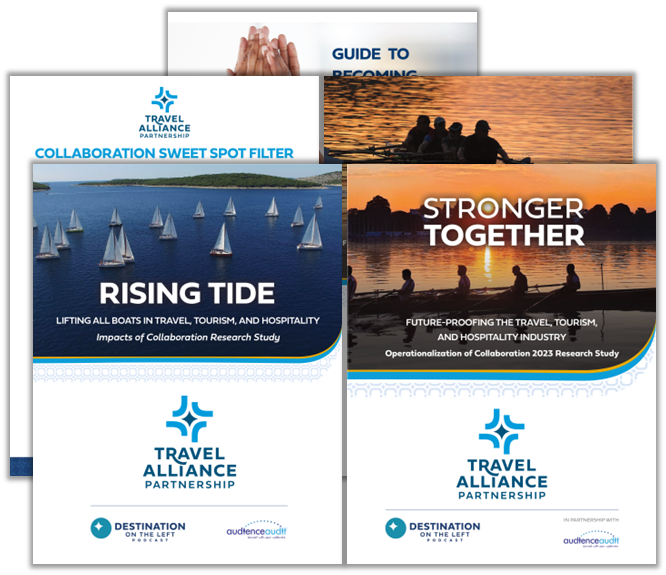
Our first research study confirmed that collaboration is a constant in the travel, tourism and hospitality industry. It is not a matter of if, but when and how, organizations will collaborate together. Our latest study reveals how organizations are putting collaboration into operation and how they are setting up systems and processes so that collaboration becomes a strategic part of the organization.
"*" indicates required fields