From Transactional to Transformational: Rethinking Partnerships
Partnership is one of those words we use a lot in the travel and tourism industry. We have marketing partners. Community partners. Funding partners. Industry partners. Strategic partners. We partner on campaigns, events, research, content and countless other initiatives.
But I have been thinking lately about what we actually mean when we call someone a partner. Sometimes what we call a partnership is really a transaction.
- You contribute $10,000. I contribute $10,000. We buy $20,000 worth of advertising.
- You provide the venue. I bring the attendees.
- You give me access to your audience. I give you access to mine.
There is nothing wrong with these types of relationships. Transactional partnerships can be incredibly valuable. They allow us to pool resources, extend our reach and accomplish things more efficiently. But there is another kind of partnership. Transformational partnerships ask us to think differently. Instead of simply exchanging value, the partners create new value together.
That distinction has been on my mind as we have been thinking more strategically about collaboration at TAP.
What Changes When We Stop Leading With the Transaction?
Recently, I wrote about two concepts I believe are important ingredients for collaboration: curiosity and being relentlessly helpful. They may not sound like business strategies, but I have seen how they are directly connected to transformational partnerships.
Curiosity Changes the Questions We Ask
Instead of approaching another organization with a predetermined idea of what we want them to do, we lead with curiosity. We ask: What are you working toward? What challenges are you trying to solve? What opportunities do you see? Where might our goals overlap?
Being Relentlessly Helpful Changes What We Bring to the Relationship
Instead of asking what we will receive in return, we start by considering what knowledge, connections, resources or perspective we can contribute.
Neither approach starts with the transaction. They start with the relationship. When we invest in the relationship first, we create room for possibilities that neither partner may have seen at the beginning.
Our Research Points to the Same Thing
Our research into collaboration in the travel, tourism and hospitality industry reinforces this idea.
In our original Collaboration Impact Study, 71% of respondents said collaboration brought increased innovation or fresh thinking, and another 71% said it improved their relevance to customers and prospects. Economic benefits mattered too—66% experienced them—but the value of collaboration clearly extended beyond simply pooling dollars.
Our later research into operationalizing collaboration went even further. We found that 87% of respondents agreed that an open-minded approach is essential to successful collaboration. The qualities they identified as most important to a collaborative mindset included communication, open-mindedness, flexibility, active listening and being a team player.
When you think about it, those aren’t transactional skills like logistics and coordination, timeliness. They are relationship skills. While both types are great skills to have, the key distinction here is that an open-minded approach backed by relationship skills is most valuable during collaboration. That’s what it takes to create transformation.
A transaction can be managed with a contract, a budget and a list of deliverables. A transformational partnership requires us to listen, adapt, trust one another and stay open to where the relationship might lead.
That doesn’t mean we abandon structure. In fact, our research shows the opposite. Successful collaboration requires clear goals, leadership involvement and proactive planning. But the structure supports the relationship. It shouldn’t limit what the relationship can become.
Think “Alongside” Not “Under”
One of the ideas that stayed with me from my recent conversation with Matt Pivarnik, CEO of the Greater Myrtle Beach Collaborative, was his use of the word alongside.
Matt described a model where tourism, economic development, business and community organizations maintain their own areas of focus while working alongside one another toward something larger. They aren’t giving up their individual goals or identities. They’re asking how those individual strengths can contribute to a shared vision for the community.
That shift in perspective is at the heart of transformational partnership.
As Matt put it:
“As soon as you put egos aside and you start just doing what’s right for the community, it’s just a no-brainer to collaborate.” — Matt Pivarnik
It sets a different tone for the beginning of a partnership. Instead of asking “What will my organization get out of this?,” transformational partners ask “What can we accomplish together?”
In Myrtle Beach, that thinking has evolved into Collaborate 2031, a community-wide strategy built around a shared vision encompassing 15 communities. Rather than creating separate tourism, economic development or legislative plans, the community is looking collectively at where it wants to go and how different organizations can help get there.
That is what working alongside can make possible. The partnership becomes a vehicle for accomplishing something bigger than any one organization could accomplish on its own.
Transformational Doesn’t Mean Equal
There is another misconception that can keep partnerships transactional: the idea that everything has to be equal.
Our research found something interesting here. Collaborators did not believe every participating organization had to contribute exactly the same amount of work. What mattered was that each organization felt good about the effort it contributed and the benefit it received.
Partners rarely come to the table with identical resources.
- One organization might bring funding.
- Another might bring an audience.
- Another might bring expertise.
- Another might have relationships or distribution channels.
- Another might simply have the ability to convene the right people.
Transformational partnerships aren’t built by making everyone’s contribution identical. Rather, they require understanding what each partner uniquely brings and combining those strengths around something they couldn’t accomplish independently.
Sally Berry offered a great example when we talked about Great Lakes USA on Destination on the Left Episode 489.
By bringing destinations together regionally, the organization can pursue opportunities that would be difficult for smaller DMOs to access individually. Sally described cooperative advertising programs where enough destinations buying in together creates a level of promotion that some smaller organizations couldn’t afford on their own.
“As long as we work as a region, market ourselves as a region, work cooperatively, spend our resources better together…” — Sally Berry
Each destination remains its own destination. But together, they become a region with a much stronger story and greater market presence.
Ask a Bigger Question
We need transactional partnerships. There will always be times when organizations need to pool a budget, sponsor an event, share content or work together on a defined project. But we shouldn’t stop there. Some of our most valuable partnerships may begin with a transaction. The opportunity is to recognize when there is potential for something more.
- What if the co-op campaign becomes a new product?
- What if the event partner becomes a research partner?
- What if the neighboring destination becomes part of a regional visitor experience?
- What if the organization you think of as a competitor becomes the partner that helps both of you reach an entirely new market?
Transformational partnerships require us to be curious enough to see those possibilities, open-minded enough to explore them and committed enough to build the relationships that make them possible.
So take a look at the partnerships your organization has today. Which ones are primarily transactional? And which relationships have the potential to become something bigger?
See what happens when you start your next conversation with: What could we create together that neither of us could create alone?
Related Posts
Commitment: World-Changing Collaborations
World-changing collaborations are grounded in the Three C’s of Collaboration: Communication, Commonality, and Commitment. This framework is based on over 5 years of podcast interviews,…
Co-opetition: Good For Business
I am a huge believer in co-opetition – where perceived competitors cooperate and together create something bigger than they could do on their own. It…
Collaboration Toolkit
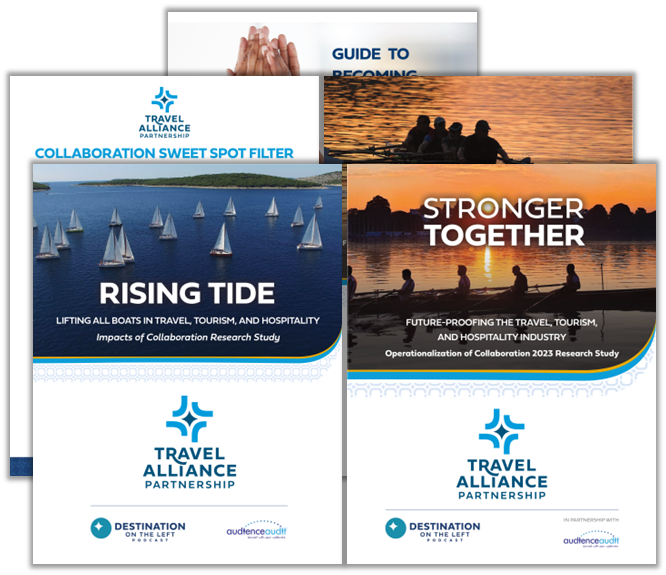
Our first research study confirmed that collaboration is a constant in the travel, tourism and hospitality industry. It is not a matter of if, but when and how, organizations will collaborate together. Our latest study reveals how organizations are putting collaboration into operation and how they are setting up systems and processes so that collaboration becomes a strategic part of the organization.
"*" indicates required fields