Growth Mindset in Tourism: 5 Lessons for Destination Marketers
“…mindsets change what people strive for and what they see as success.”
– Carol S. Dweck, Ph.D.
At Travel Alliance Partnership, being Growth-Minded is more than a phrase on our list of core values. It’s part of how we work. We challenge ourselves to keep learning, growing, changing and adapting — because the travel, tourism and hospitality industry never stands still.
That idea has stuck with us since our team read Carol Dweck’s Mindset: The New Psychology of Success. The book helped us put language around something we already believed: being growth-minded isn’t simply about moving forward. It’s about being willing to learn, take risks, fail, rethink and try again.
And in destination marketing, there are plenty of opportunities to do all of those things.
So, what can a growth mindset look like in destination marketing? Here are five lessons that continue to shape our approach.
Keep Finding the Fun
After years of marketing the same destination, attraction, restaurant, winery or trail, it’s easy to forget just how interesting it is.
We hear it all the time. A client tells us about something happening in their destination and then immediately downplays the “cool” factor because, to them, it’s familiar. But familiar doesn’t mean uninteresting. What feels ordinary to us marketers can be exciting to someone discovering it for the first time.
The Wayne County Apple Tasting Tour is a great example of this. The Tour brings together a collection of farms, farm markets and wineries celebrating apples during October. Other areas of the state have farms, apples, corn mazes, and cider. But Wayne County’s differentiator is that is it the largest apple-producing county in New York State. The tour offers a full day of experiences: a reason to explore, collect stamps or digital badges, discover new businesses and make family memories. We worked with Wayne County for almost two decades on the Tour, innovating the experience year after year. One year, we even gamified it!
So, the next time you feel stale, visit your partners again. Take the tour. Stay overnight. Walk the trail. Try the experience. Watch visitors experiencing it for the first time. Ask yourself what would make you stop, explore, share or come back. Then keep finding the fun.
Turn Challenges Into Opportunities
Tourism is full of challenges. From seasonality to limited resources, to changing traveler behavior, to a shifting economy, to new competition.
A fixed mindset sees a problem. A growth mindset asks: What could this make possible?
TAP saw that question play out with the National Baseball Hall of Fame. In 2025, the museum prepared to launch a new exhibit exploring the history of Japanese baseball, coinciding with the anticipated induction of Japanese baseball star Ichiro Suzuki, who played for the New York Yankees, Miami Marlins and, most recently, the Seattle Mariners. This once-in-a-generation cultural moment created an opportunity to expand awareness and diversify visitation by engaging new audiences beyond the Hall of Fame’s traditional markets.
We leveraged a sports tourism trend that saw fans trying to visit every baseball stadium in the U.S. and turned it into a drive market opportunity by creating inspirational itineraries that would encourage fans from new markets to plan bucket-list baseball getaways. Then, we created a high-performing campaign landing page and ran digital ads encouraging strong audience interest and engagement beyond induction weekend.
The important shift wasn’t simply a new campaign. It was a new way of looking at the problem.
We took a moment and turned it into a movement.
When a problem or challenge presents itself, ask what growth opportunity can be found in the solution. Does our assumption need to change? What audience haven’t we considered? Is there a side of the story we haven’t yet told?
Stop Protecting “The Way We’ve Always Done It”
The tourism industry has never been particularly good at standing still — and 2026 certainly isn’t making that easier.
AI is changing search and discovery. Travelers are consuming information in new ways. Social platforms continue to evolve. The economy has visitors rethinking value. And destination organizations are expanding their role from marketing to management, stewardship and community engagement.
The answer isn’t to chase every shiny new thing. It’s to stay curious.
The Keuka Lake Wine Trail started asking the right questions around its Tasting Passport last year. Sales were stagnant, the wine trail audience wasn’t growing, and the price point of the passport was being called into question. We worked with the Trail to conduct research around audience expectations, market trends, and competition—resulting in the Trail launching not one, but three new passports with niche experiences at a lower price point. The result was a 42% increase in sales and 40% increase in overall revenue. The winery experience didn’t change, but the way it was presented did.
That’s the sweet spot of a growth mindset: knowing what is worth protecting while remaining open to a better way of doing it.
Take the Right Risks
Growth requires some risk. But not every risk needs to be a leap.
Sometimes it’s a pilot campaign. A new audience. A different story. A new partnership. A test before a full investment.
One of the best tourism examples we’ve seen is also one of the simplest: asking whether a destination can change the way people perceive something they already know.
Visit Syracuse didn’t try to hide winter. It leaned into it. The result was a bold repositioning that invited visitors—and even local partners—to see the season differently. The campaign earned more than 561 million media impressions and helped tourism partners reconsider winter as a viable market. And to date, it’s the TAP project we keep coming back to, the exciting moment we pushed the envelope just far enough.
That’s the kind of risk worth taking: the kind that challenges an assumption and creates something new to learn.
Let Failure Teach You Something
Not every idea will work.
That’s not a flaw in the process. It is the process.
A campaign might miss its audience. A new message might fall flat. A new platform might not deliver. An experience might need to be reworked. The growth-minded response isn’t to pretend the failure didn’t happen. It’s to get curious about it.
We’re always debriefing after every campaign, every proposal, every engagement: What did we learn about the traveler or the destination? Was our presumption wrong? What did the data tell us? Would we change something next time?
Our work is full of examples where an idea evolved mid-campaign because the industry, the audience or the circumstances changed.
That’s part of the work. We don’t need every idea to be perfect. We need to be willing to learn from every idea. And sometimes, the lesson from something that didn’t work becomes the starting point for something that does.
Keep Growing
A growth mindset doesn’t mean having all the answers. It means staying curious enough to keep asking better questions, being willing to try something different and paying attention to what happens next.
That matters in an industry that is always changing. Travelers change. Technology changes. Communities change. The way we market, manage and talk about destinations has to evolve with them.
Being growth-minded gives us permission to evolve, too. To find the fun again. To see possibility in a challenge. To question what we’ve always done, take thoughtful risks and learn from the ideas that don’t go as planned.
Because growth isn’t about getting everything right. It’s about staying open to what we can learn next.
Related Posts
How Tourism Brand Ambassadors Elevate Your Destination Story
In today’s world, it can seem like everything in marketing and sales has changed. But the one thing that hasn’t changed is the value of...
Collaboration Toolkit
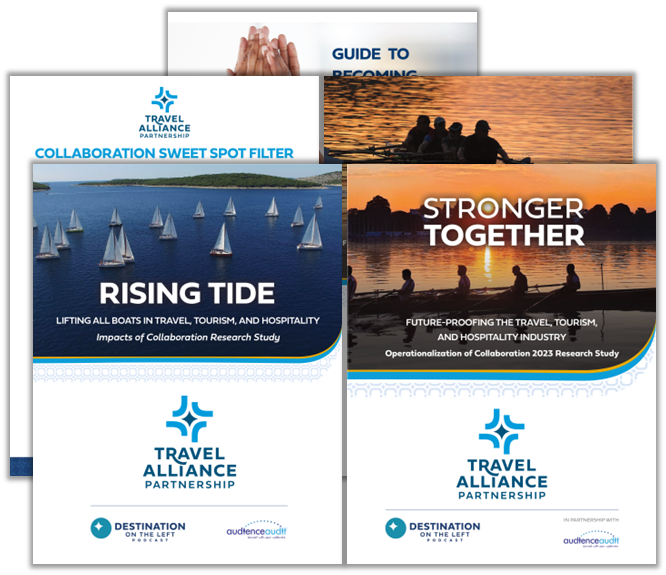
Our first research study confirmed that collaboration is a constant in the travel, tourism and hospitality industry. It is not a matter of if, but when and how, organizations will collaborate together. Our latest study reveals how organizations are putting collaboration into operation and how they are setting up systems and processes so that collaboration becomes a strategic part of the organization.
"*" indicates required fields