How to Turn Destination Stewardship Into a Visitor Experience
When we discuss destination stewardship, it often starts behind the scenes, with a focus on protecting natural resources, preserving cultural traditions, supporting residents, and thinking carefully about tourism’s impact on a place.
But what happens when stewardship also becomes something visitors can experience?
Connecting stewardship to the visitor experience creates an opportunity to link responsible tourism with the reasons people travel in the first place. Visitors can learn something new, participate in the places they visit, and come away with a deeper understanding of what makes those places distinctive.
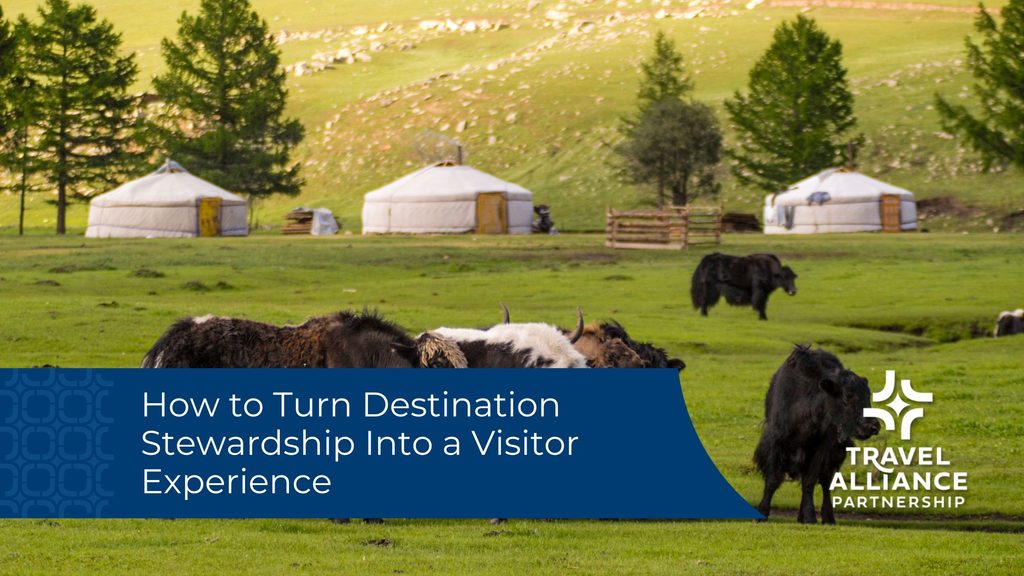
Recent conversations on the Destination on the Left podcast offer two very different examples of this approach. In Destin-Fort Walton Beach, Florida, natural-resource initiatives have become connected to outdoor education and visitor experiences. In Mongolia, Nomadic Expeditions founder Jalsa Urubshurow has spent decades connecting tourism with cultural preservation, local leadership, conservation, and community participation.
Their experiences offer a useful framework for turning destination stewardship from an organizational priority into a meaningful part of the visitor experience.
Start With What Makes Your Place Worth Caring About
The strongest stewardship experiences begin by focusing on what’s already happening in a destination and where visitors can become part of it. Ask questions like:
- What do locals care about?
- What natural resource needs attention?
- What cultural tradition is important to the community?
- What challenge are people already trying to solve?
In Episode 479 of Destination on the Left with Alex Fogg and Jennifer Adams, Destin-Fort Walton Beach offers a great example. The destination is known for its beaches, but its tourism work doesn’t stop at getting people to the beach. Its coastal and natural resources team is involved in everything from fisheries and sea turtles to artificial reefs, waterways, and marine restoration. That creates opportunities to connect visitors with the place in ways that go much deeper than simply spending a day near the water.
One particularly interesting opportunity emerged from a problem: the lionfish.
Lionfish are an invasive species, which sounds more like the beginning of a natural-resource management discussion than a tourism experience. But what began as very science-focused grew into something visitors could participate in. Visitors can encounter lionfish through diving, education, competition, events, and local dining. Visitors aren’t just being told that conservation matters; they have an opportunity to understand the issue and take part.
That’s a useful way to think about destination stewardship. Look first at what your place genuinely needs or values. A compelling visitor experience may already be hiding inside work your community is doing.
Give Visitors a Meaningful Role in the Experience
Finding the opportunity is one thing. The next step is figuring out how visitors can participate in a way that feels natural and worthwhile.
Destin-Fort Walton Beach has done this through its Little Adventures programming. They connect visitors with local experts who teach activities such as fishing, surfing, snorkeling, paddleboarding, and stargazing. The experiences give families something fun to do, but they also introduce visitors to the people, skills, and natural resources that are part of everyday life in the destination.
Instead of simply telling visitors why a resource is important, you can give them a way to experience it for themselves.
Make Participation Accessible
Meaningful participation doesn’t have to mean asking visitors to devote a day of their vacation to conservation work. There can be different entry points depending on the visitor, the experience, and the destination.
A family with young children might start by learning how to fish from shore, while another family learns about sea turtles. An experienced diver might participate in lionfish removal. Each activity requires a different level of involvement, but all of them can help visitors better understand the relationship between recreation and the natural environment.
Those experiences can also build on each other. Jennifer described creating a progression: learn to fish from shore, move on to a pier, and eventually book a charter. That gives visitors room to deepen their interests while also creating connections with local businesses and experts.
We’ve taken a similar approach in our work with Tour Cayuga. The Go Beyond campaign introduced visitors to some of Cayuga County’s less expected outdoor experiences while also providing information to help them explore responsibly. It’s a good reminder that participation doesn’t always have to mean joining a conservation program. Helping visitors discover a natural resource, understand how to enjoy it responsibly, and feel confident trying something new can also be part of the stewardship experience.
Let Local Experts Lead
The people delivering these experiences are an important part of what makes them work. Local knowledge comes up again in Episode 471 of Destination on the Left, where Nomadic Expeditions founder Jalsa Urubshurow talks about the role local guides play in creating authentic experiences in Mongolia.
For decades, Jalsa has invested in guide training as part of Nomadic Expeditions’ approach to tourism. He sees guides as more than people who move travelers through an itinerary. Their knowledge of the culture, history, and everyday life of Mongolia helps visitors develop a deeper understanding of the place and the people who live there.
For tourism organizations, that means thinking beyond who can operate an activity. Rather, who can make the experience richer? Bringing local experts into the experience helps keep stewardship grounded in the community itself. Visitors hear from the people who know the resource, practice the tradition, or do the work, rather than experiencing a version created solely for tourism.
Design the Experience to Benefit the Place, Too
Visitor participation is only one side of destination stewardship. The experience should also create value for the community, culture, or natural resource at the center of it.
Jalsa’s story about Mongolia’s Golden Eagle Festival illustrates this well. The festival began with an effort to preserve an important cultural tradition, not as an attraction for tourists. Over time, travelers became interested and tourism created additional opportunities around the tradition.
Rather than starting with what could be packaged for visitors, the work started with something the community valued and wanted to preserve. Tourism then became one way to support and share it.
As you develop a stewardship experience, consider who benefits if it succeeds.
- Does it create opportunities for local guides or businesses?
- Does it strengthen appreciation for a cultural tradition?
- Does it support conservation work or help visitors understand how their behavior affects a natural resource?
The answers will be different in every destination. The goal is to design an experience where visitor value and community value reinforce each other without competing.
Tell the Story Without Overclaiming
Once stewardship becomes part of the visitor experience, marketing has an important role to play. But you don’t necessarily need to lead with a broad claim about sustainability.
Start with what people can actually experience. They might learn a new outdoor skill, explore an ecosystem with someone who knows it well, participate in conservation work, or encounter a cultural tradition through the people who practice it.
Then give them the context that makes the experience meaningful. Explain why the work matters, who is involved, and what the destination is trying to protect or strengthen. Making local experts and partners visible can also help visitors understand that stewardship is a shared effort, not simply a tourism campaign.
We’ve seen this approach in our own work with Akwesasne Travel. In developing a marketing strategy for the destination, the focus was on helping travelers connect with Akwesasne Mohawk culture through the experiences, traditions, and stories that make the community distinctive. Rather than treating culture as a marketing theme, the strategy put cultural experiences at the center of how potential visitors could understand and connect with the destination.
This approach makes it easier to be specific about what an experience does without asking one program to carry a sweeping “sustainable” label. A conservation component alone doesn’t tell the whole story. How the program operates, who shapes it, and what happens as a result matter too.
Jalsa, Alex, and Jennifer reinforce another important point: stewardship is ongoing. Programs evolve, partnerships grow, and new challenges emerge. Being open about that process can be more credible than suggesting a destination has sustainability completely figured out.
Measure Whether the Experience Creates Shared Value
If destination stewardship becomes part of the visitor experience, participation and bookings can tell you something about its success, but they shouldn’t be the only measures.
Start with the visitor experience. Did people learn something or develop a stronger connection to the destination? Did the activity encourage them to explore another local experience or engage with a local business?
Then look at the community. Are local experts and businesses meaningfully involved? Does the experience create opportunities for residents? If it involves a cultural tradition, are the people connected to that tradition helping shape how it is shared?
Environmental or cultural outcomes will require their own measures. A lionfish initiative, for example, needs a very different definition of success than a cultural preservation program. Work with the people who understand the resource to identify what progress actually looks like rather than relying on a broad sustainability claim.
Ultimately, that wider view of success gets at what destination stewardship can add to the visitor experience. Visitors are getting a chance to understand it, meet the people who care for it, and sometimes participate in that work themselves.
When the experience grows from what a place genuinely needs or values, that connection feels natural. And it can turn stewardship into something visitors don’t just hear about, but something they remember as part of the trip.
Author
Related Posts
Destination Podcasts: Telling Your Story
It’s no secret that we’re huge fans of podcasts at Travel Alliance Partnership. We have our own podcast, Destination on the Left, that explores creativity…
4 Tips to Plan a Successful FAM Tour
In the wonderful and exciting world of tourism marketing, there are countless ways to showcase a destination, but few are as effective as a well-planned…
Collaboration Toolkit
Our first research study confirmed that collaboration is a constant in the travel, tourism and hospitality industry. It is not a matter of if, but when and how, organizations will collaborate together. Our latest study reveals how organizations are putting collaboration into operation and how they are setting up systems and processes so that collaboration becomes a strategic part of the organization.
"*" indicates required fields